
By the TDSA Ecosocialism Association
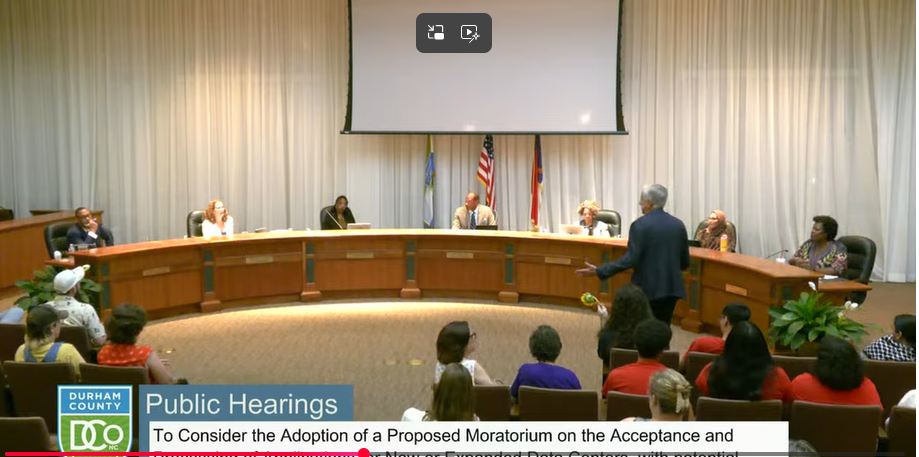
(Scott Levitan, CEO & President of RTP, shrugging during the August 24, 2026 Durham County Commissioners meeting)
It is widely assumed that the political struggles people pay the least attention to are the ones that are closest to home. AI data centers are changing this. In both red and blue states, people are crowding normally barren local government meetings to stop the plague of large-scale AI data centers from reaching their doorstep.
On August 24th, the data center fight arrived in Durham, North Carolina. At a Monday evening meeting that ran from 7pm until midnight, county commissioners Mike Lee, Michelle Burton, Wendy Jacobs, Nida Allam, and Stephen Valentine appeared aligned on passing a moratorium on data centers, but divided on how comprehensive a ban should be. Despite an overwhelming majority of public comments urging a moratorium without carveouts, the commissioners voted 4-1 for a moratorium that included major loopholes. Allam was the lone dissenting vote.
The most significant of these was a carveout allowing for the construction of new data centers in Durham County, as long as they are less than 100,000 square feet. County commissioners spun this as a reasonable measure to allow for the construction of so-called “enterprise” data centers, and claimed that 100,000 square feet is well short of what counts as “hyperscale.” Yet this is enough space to build a data center with a power draw of up to 100 megawatts, the equivalent of powering 80,000 households or over 63% of City of Durham households. Such a facility could further consume 530,000 or more gallons of water per day, once both on-site and indirect water consumption is accounted for.
Even though the public supermajority supporting a loophole-free moratorium was largely ignored by the county commissioners this time, we should not rush into the mistaken conclusion that public hearings are unimportant or without value. The opposite is true. In fact, one of the biggest reasons why we’re seeing local governments across the country pass moratoriums on data centers in the first place is because of local communities organizing themselves to make their data center opposition as vociferous as possible inside the halls of local power. However, in places like Loudoun County, the proliferation of data centers despite this resistance belies a dirty truth about local “democracy” that speaks to the need to organize a powerful working-class movement both within and beyond the county commissioner’s chambers.
One moment of the debate is worth focusing on to understand the power dynamics lurking behind what took place. After hours of deliberation and public comment, Commissioner Jacobs invites someone from the audience whom she refers to as “Mr. Levitan” to come up to the microphone to provide more context on a question she raised about the Research Triangle Park (RTP) zoning process. As Mr. Levitan makes his way to the microphone, someone else from the audience interrupts, claiming that if Mr. Levitan will be receiving an extra opportunity to speak, so should every other member of the public. The person who interrupts the meeting is then admonished by Chair Lee for interrupting. This interaction encapsulates the political fissures that underlie both Monday’s contentious meeting and local politics writ large in this country.
City council and county commissioner meetings create a certain temporal illusion. During the timespan of a public hearing, local government bodies give the impression that every member of the public has an equal opportunity to influence the debate at hand by ostensibly granting every member of the public an equal amount of time to speak. The interaction described above shatters this illusion. Mr. (Scott) Levitan is not county staff, or another county commissioner. He is the CEO & President of RTP Foundation, and one of only two out of sixty speakers at the public hearing who urged the commission to vote for a moratorium with carveouts, which is what they ultimately did.
Were the opinions of the two speakers who asked for the moratorium with loopholes more persuasive than all the other sixty or so speakers? Why was a particular member of the public granted extra speaking time? What would’ve happened if the interaction wasn't interrupted?
While the details of exactly what happened behind closed doors are not known, we do know some things. Mike Lee publicly asked for exemptions that allow large 75-80 megawatt data centers. Since local governments in North Carolina cannot directly regulate energy use, the strategy switched to square footage. Scott Levitan was the only supporter of a 100,000 square foot loophole at an earlier work session on August 3rd. The staff who wrote the ordinance only listened to public directions from Lee and Jacobs, both of whom have never faltered to address their “stakeholders” (businesses in RTP and Treyburn) since the beginning of public meetings on this topic.
The cozy relationship capitalists enjoy with many politicians isn’t breaking news. But what happened at the county commissioners meeting was a prime example of just how this undemocratic process works. Capitalists like the CEO of the RTP foundation get increased access to elected officials, shaping “the public hearing” even before “the public hearing” takes place. Furthermore, the AI-funded Trump administration’s federal budget cuts create an extra layer of economic pressure on the shoulders of Durham’s elected officials to cater to the whims of tech companies and their promises of economic development. How this development will materialize equitably from a technology whose main selling point is replacing workers, or at best paying them less to do more, remains a mystery. This is to say nothing of how the data center boom is driving up water and energy bills, sucking up water in drought-stressed areas, and delaying the energy transition.
None of this is anything new in the Triangle. The history of RTP reveals that it has been a top-down, corporation-centric project from its very beginnings in the 1950s. Originally cooked up by a small group of capitalists, academics, and government officials, the “Research Triangle” development strategy was meant to change the face of North Carolina by attracting tech companies and knowledge workers to a state dominated by a few low-wage materials processing industries; namely textiles, tobacco, and furniture. While some have certainly prospered thanks to RTP, this same development strategy has time and time again reinforced class inequalities, gentrified historically Black neighborhoods, and facilitated unsustainable, unaffordable, car-centric suburbanization. It also has failed to substantially improve the lot of much of North Carolina’s working class both within and beyond the Triangle, which continues to face low wages, poor working conditions, a degraded environment, and aggressive union busting. This is precisely because RTP did not break with earlier patterns of development in North Carolina so much as supercharge them under the guidance of a detached and dictatorial technocracy.
Despite their long-held sway over regional politics, the movement to oppose the data center boom increasingly has something capitalists do not: public support. A Gallup Poll from March found that seven in ten Americans oppose constructing data centers for artificial intelligence in their local area. This discontent has manifested in grassroots coalitions that have emerged throughout the country. Durham’s Stop Data Centers campaign, of which NC Triangle DSA is a co-sponsor, has played an important role in organizing the community to pack local government meetings and was instrumental in obtaining a recent year-long moratorium at the city level.
Although the county commissioners ultimately sided with Mr. Levitan and RTP’s business elites over the people, the fight is not over. Expected growth trends in both RTP and Duke Health arc towards a probable future of ever more consequential AI data center fights. The degree to which Durham and other cities and towns across the country will be able to thwart the whims of the AI capitalist class is dependent on the degree to which they can organize their communities to stop the rise of the Musks and the Altmans and their machines. Because ultimately, the fight over AI data centers is more than just a technocratic fight over emerging technology and its regulations. At its core, it’s a fight for our democracy, our humanity, and the land, water, and air that we all depend on to survive and to thrive.